
Designing the Pluriverse
Putting Escobar’s Theory into Practice Through Digital Storytelling
By Kawther Ramadan
Universities often present themselves as spaces of diversity, openness, and intellectual exchange. Yet when it comes to the deeper structures that define what counts as legitimate knowledge, that diversity is far more limited than it appears. Western epistemologies continue to dominate academic life, while Indigenous, non-Western, and community-rooted ways of knowing are too often marginalized, appropriated, or dismissed. These exclusions are not accidental. They reflect the enduring power structures built into higher education itself.
This article begins from that concern. It brings Arturo Escobar’s Designs for the Pluriverse into conversation with my own research project, the Digital Storytelling Lab (DSL), to ask what it might mean to move from decolonial theory to decolonial practice. While Escobar offers a powerful critique of Western modernity and its “one-world world,” he leaves open an important question: how can these ideas be enacted inside academic institutions? My response is the Digital Storytelling Lab—an experimental, participatory, and arts-based research space that uses multimedia storytelling to challenge extractive research practices and expand what counts as knowledge.
Arturo Escobar’s work offers one of the most compelling foundations for rethinking knowledge production beyond Eurocentric frameworks. At the center of his argument is the idea of the pluriverse: a world where many worlds fit. Rather than assuming there is one universal path to knowledge, progress, or transformation, Escobar argues for ontological pluralism—the recognition that multiple realities and ways of knowing coexist, each shaped by its own histories, relationships, and practices. This is not simply a theoretical claim. It is deeply political, because it asks who has the power to define reality, whose knowledge is treated as legitimate, and what forms of life are made visible or invisible through dominant systems.
For my research, Escobar’s framework is especially valuable because it refuses the idea that knowledge production is neutral. It makes visible how modern institutions, including universities, are shaped by assumptions that privilege individualism, hierarchy, dualism, and abstraction. Against this, Escobar offers relationality, autonomy, and community-rooted design as alternative foundations for world-making.
One of the most actionable parts of his work is the concept of autonomous design. Escobar does not treat design as a purely technical or aesthetic process. Instead, he frames it as a political and collective activity through which communities shape their own futures according to their own values, histories, and relational logics. Design, in this sense, becomes world-making. This matters for research. If research continues to operate through extractive models—where communities are studied, interpreted, and translated by outside experts—then it remains tied to the same modernist logic Escobar critiques. Autonomous design offers another possibility: research as co-creation, rooted in community agency, relational ethics, and shared authorship.
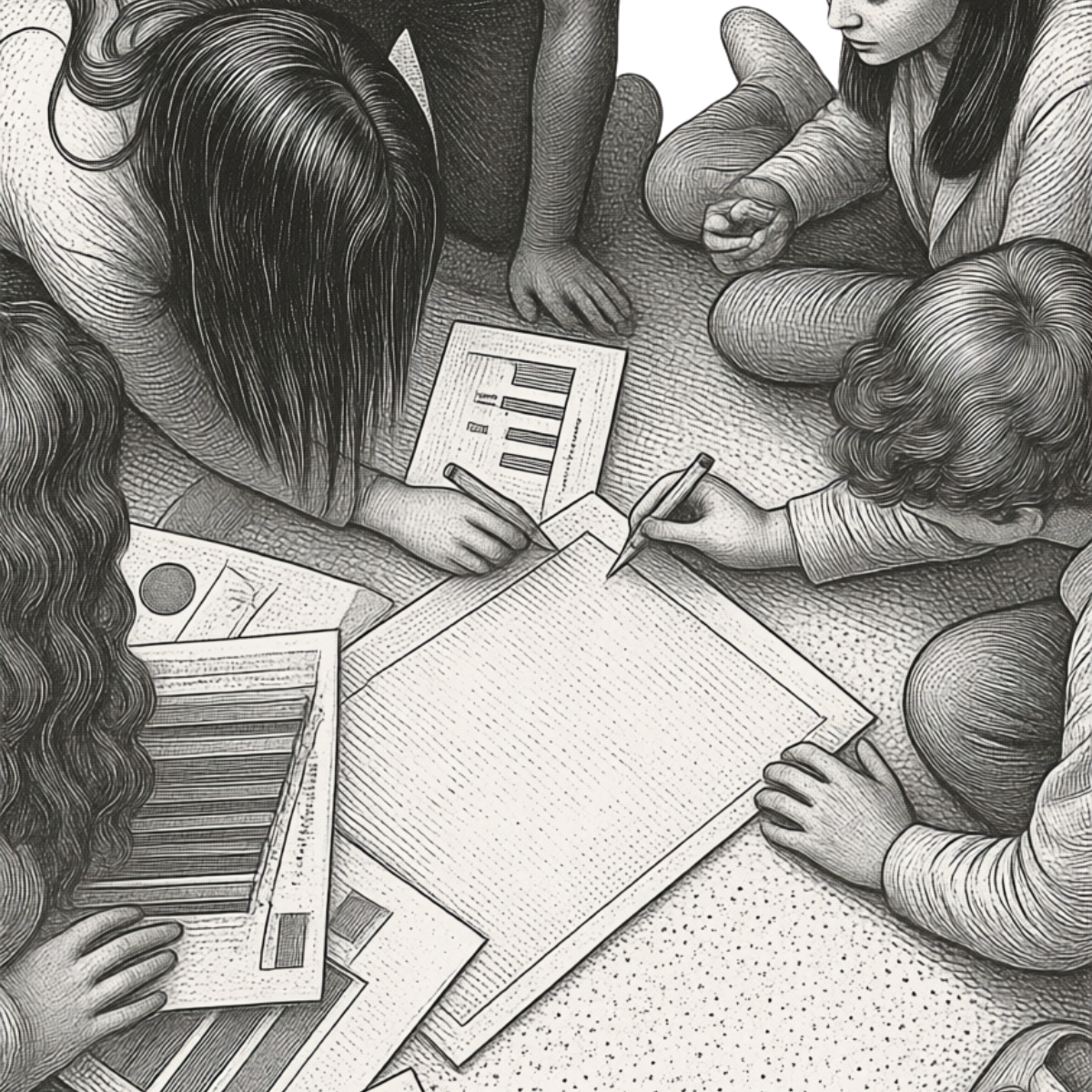
This is where the Digital Storytelling Lab enters. The DSL is an experimental research space designed to bring decolonial theory into practice. It integrates multimedia storytelling, participatory methods, and community-driven narratives to challenge dominant academic norms, especially those that privilege text-based, Eurocentric, and hierarchical forms of knowledge production. The Lab centers the stories and activist work of Generation Z Arab, Palestinian, and Muslim women in Canada. Through digital storytelling, it creates space for these young women to reflect on identity, resilience, belonging, and resistance, while producing counter-narratives that challenge marginalization and epistemic erasure.
The DSL is both a platform and a method. It is a platform because it offers a creative, collaborative, and accessible space for storytelling through video, voice, image, and digital media. It is a method because it treats storytelling not as representation alone, but as a form of knowledge-making grounded in lived experience, co-creation, and community accountability. In this way, the Lab does more than illustrate Escobar’s theory. It enacts it.
Escobar offers a rich conceptual framework, but much of his work remains abstract when it comes to institutional application. He shows us why Western modernity must be challenged, but gives fewer concrete models for how that challenge might be practiced within academic research, pedagogy, or institutional life. The Digital Storytelling Lab responds directly to that gap. It operationalizes several of Escobar’s key ideas: relationality, by treating knowledge as something produced through connection rather than isolation; ontological pluralism, by recognizing multiple forms of knowledge beyond written argument alone; autonomous design, by positioning participants as co-creators of meaning rather than data sources; and resistance to extraction, by supporting storytelling as a practice of shared authorship, reflection, and empowerment.
Escobar’s work also sits within a wider decolonial conversation. His critique of Western epistemology resonates strongly with Linda Tuhiwai Smith’s call to decolonize research and reclaim Indigenous and community-rooted knowledge systems. It also overlaps with Eduardo Gudynas’s critique of epistemic extractivism, where academic institutions take knowledge from marginalized communities without reciprocity or structural transformation. At the same time, Escobar’s emphasis on design distinguishes him. Where others focus primarily on critique, he asks how alternative worlds can actually be made.
This is also where his work connects with Alex Khasnabish’s writing on the radical imagination. If Escobar gives us the ontological architecture of the pluriverse, Khasnabish helps us think about the affective, political, and collective labor required to sustain it. Together, they point toward a research practice grounded not only in critique, but in creativity, struggle, and world-building. The DSL draws these threads together. It becomes a space where participants can tell stories, imagine otherwise, and enact forms of knowledge that resist dominant narratives.
At the same time, important gaps remain in the literature. Much of the scholarship on decoloniality, pluriversal knowledge, and participatory research is conceptually rich but offers limited guidance for how to transform research practices or academic institutions in concrete ways. Escobar is no exception. His work is inspiring, but often stops short of practical implementation. There is also limited attention to intersectionality. While Escobar emphasizes relationality and autonomy, he does not fully engage the ways race, gender, class, migration, and colonial histories shape who has access to knowledge-making spaces. Without this, even transformative frameworks risk reproducing exclusion. His relational stance is powerful, but it can also leave underdeveloped the everyday violence and lived inequalities that shape people’s possibilities. And like much decolonial theory, while the critique of the university is compelling, the roadmap for transforming it remains unclear.
These are the gaps my project attempts to address. The Digital Storytelling Lab brings Escobar’s theory into an applied academic setting while also extending it through intersectional, arts-based, and community-centered practice. By centering the lived experiences of Arab, Palestinian, and Muslim women in Canada, the Lab grounds pluriversal theory in actual stories, actual relationships, and actual conditions of struggle. This matters because decolonial knowledge cannot remain only theoretical. It must be practiced.
The DSL contributes by creating a concrete model of non-extractive, participatory research; centering marginalized voices as knowledge producers rather than subjects; using multimedia storytelling to challenge the dominance of text-based academic knowledge; and bringing creativity, embodiment, and lived experience into research design. In that sense, the Lab is not just inspired by Escobar. It tests his ideas in practice.
As universities continue to confront their colonial legacies and epistemic hierarchies, there is an urgent need for models that move beyond critique and toward transformation. Escobar’s Designs for the Pluriverse offers a powerful starting point. His concepts of relationality, autonomous design, and ontological pluralism provide an important framework for reimagining knowledge beyond Eurocentric and extractive traditions. But theory alone is not enough.
The Digital Storytelling Lab responds to this challenge by offering a concrete, creative, and participatory intervention within academic research. Grounded in storytelling, co-creation, and care, it demonstrates one way the pluriverse can be enacted rather than simply described. In doing so, it contributes to a broader decolonial project: building academic spaces where many worlds of knowledge can not only survive, but shape the future.
References
Banerjee, S., Lucas dos Santos, L., & Hulgård, L. (2023). Intersectional knowledge as rural social innovation. Journal of Rural Studies.
Escobar, A. (2018). Designs for the Pluriverse. Duke University Press.
Goodchild, M. (2021). Relational systems thinking. Journal of Awareness-Based Systems Change, 1(1), 75–103.
Gudynas, E. (2020). Extractivisms: Politics, Economy and Ecology. Fernwood Publishing.
hooks, b. (1994). Teaching to Transgress. Routledge.
Khasnabish, A. (2020). Ecologies of the radical imagination. Information, Communication & Society.
Omodan, B. I. (2024). The roles of epistemology and decoloniality in addressing power dynamics in university education. Globalisation, Societies and Education.
Tuhiwai Smith, L. (2021). Decolonizing Methodologies. Zed Books.
Wilson, S. (2008). Research Is Ceremony. Fernwood Publishing.
